International Garment Buyers List: Top Global Clothing Buyers & Importers Directory 2026
Every garment factory owner has had the same thought: the product is good, the price is competitive, the certificates are in order — so where are the buyers? Finding international clothing buyers is less a mystery than a discipline: accurate data, patient outreach, credible documentation, and a realistic grasp of how sourcing teams decide. A well-built buyers list turns a vague ambition into a repeatable process with names, categories, markets, and follow-up dates.
What Is an International Garment Buyers List?
An international garment buyers list is a structured database of overseas companies and individuals who purchase apparel in commercial quantities. It is not a list of consumers, nor simply a list of brand names: a usable list identifies the organisations that actually place production orders, with enough detail to judge whether they fit your factory.
Buyers generally fall into six categories:
- Retailers and retail chains — department stores, hypermarkets, and specialty chains that import directly, buy large volumes, and demand strict compliance
- Brands and labels — companies that design and market apparel but own no factories
- Importers and wholesalers — mid-sized traders who resell to smaller retailers; often the most realistic first customer for a new exporter
- Buying houses and sourcing agents — intermediaries sourcing for several retail clients, usually with liaison offices in Dhaka, Delhi, Tiruppur, Ho Chi Minh City, or Karachi
- E-commerce and private-label operators — Amazon and Shopify sellers, subscription brands, creator-led labels; modest volumes, but repeating
- Institutional and promotional buyers — uniform suppliers, corporate merchandise firms, hotel and airline suppliers, school and hospital uniform contractors
Users include manufacturers seeking direct orders, merchandisers building a pipeline, trading houses, textile mills, and export promotion bodies supporting member factories. Across Bangladesh, India, Pakistan, Vietnam, and Turkey, a buyers list is standard equipment for any factory trying to reduce dependence on one existing customer.
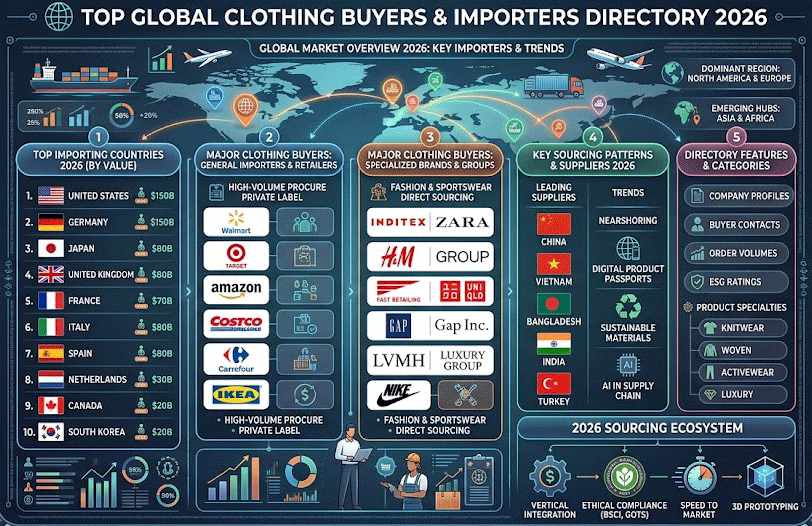
Top Global Clothing Buyers & Importers Directory 2026
Why You Need a Garment Buyers List for Export Success
Factories rarely lose money in export marketing by spending too little. They lose it by spending effort on the wrong contacts.
It replaces guesswork with targeting. A knit factory producing 40,000 basic T-shirts a day has no business approaching a luxury label with 800-piece runs of tailored silk. A list carrying category and typical order size lets you filter for buyers who match your machinery, MOQ, and lead time.
It reduces customer concentration risk. Many factories run at 70–90% of capacity for one or two buyers. When that buyer shifts sourcing countries — as many did after the 2025 round of US tariff changes disrupted supply chains and squeezed margins — there is no cushion. A buyers list is insurance built in advance.
It shortens the sales cycle. A first enquiry rarely becomes a purchase order in under three to nine months, because buyers work on seasonal calendars and require audits, sample approvals, and lab tests first. Starting with a qualified list means your pipeline is already moving when a competitor’s supplier fails.
All of this depends on data quality. Five thousand unverified addresses scraped from public directories produce bounces, spam complaints, and a damaged sending domain. Two hundred verified contacts with named merchandisers are worth far more.
Top Countries with Major International Garment Buyers
Global apparel demand is heavily concentrated. According to WTO trade statistics for 2024, the European Union was the largest importing region at roughly US$210–211 billion — about 34.3% of world apparel imports. The United States ranked second at approximately US$92 billion, close to 16%. Japan was the third-largest single-country importer at around US$25 billion, with the United Kingdom fourth at roughly 3.4%.
South Korea, Canada, Australia, and the Gulf states form a second tier. The practical implication: build depth in two or three markets rather than thin coverage of fifteen.
USA Garment Buyers and Clothing Importers
The US is the largest single-country apparel market and the one most sought after by South Asian exporters.
At the top are mass-market retailers and hypermarket chains importing enormous volumes of basics — T-shirts, polos, fleece, denim bottoms, children’s wear, underwear, sleepwear. They buy through both in-house sourcing offices and appointed agents, and impose the industry’s strictest compliance requirements. Below them sit department stores and mid-market chains buying seasonal fashion, then specialty brands in activewear, outdoor, denim, and workwear.
A large, often overlooked tier consists of importers and private-label wholesalers turning over US$5–100 million, supplying regional chains, uniform programmes, and promotional merchandise — usually the best entry point for a factory without a US track record, thanks to smaller orders and lighter approvals. The fastest-growing segment is e-commerce private label: Amazon-first brands, DTC labels, and creator-led lines wanting 300–3,000 pieces per style, fast sampling, and WhatsApp rather than formal tenders.
Expect US buyers to require CPSIA compliance for children’s apparel (tracking labels, lead and phthalate testing), flammability compliance under 16 CFR Part 1610, FTC care labelling and fibre content rules, and documentation supporting the Uyghur Forced Labor Prevention Act. UFLPA enforcement means importers now routinely request cotton traceability back to gin and farm level; factories that produce those records quickly hold a real advantage. Third-party social audits — WRAP, SMETA/Sedex, Higg FEM — are standard.
UK and Europe Garment Buyers Directory
Europe is the largest buying region and more fragmented than the US, which favours medium-sized factories.
The biggest EU importing markets are Germany, France, Spain, the Netherlands, Italy, and Poland. Germany is the EU’s largest consumer market at roughly US$73.5 billion in 2024 apparel revenue, while the UK is Europe’s largest national market near US$86 billion. The Netherlands acts partly as a re-export hub, which is why Dutch importers appear out of proportion to population. CBI data indicates developing-country suppliers accounted for 43.9% of EU clothing imports by value in 2024, down from 48.2% in 2019 — you now compete with nearshoring from Turkey, Morocco, and Eastern Europe on lead time.
European buyer types worth targeting:
- Vertical fashion retailers with trend-driven ranges and demanding calendars
- Supermarket clothing lines in the UK and France, buying large volumes of value basics
- Sustainable and organic-certified brands, where GOTS, OCS, GRS, or Fairtrade certification is mandatory rather than optional
Compliance in the EU is increasingly regulatory rather than voluntary. REACH restricts hazardous substances; OEKO-TEX Standard 100 is a widely requested benchmark; amfori BSCI audits are the social compliance norm. Ahead, the Ecodesign for Sustainable Products Regulation is expected to bring Digital Product Passport requirements to textiles, and the EU’s corporate sustainability due diligence framework will push traceability down the chain — confirm timelines with your buyers, as implementation dates have shifted more than once.
Duty access matters too: least-developed-country suppliers benefit from EU preference schemes, GSP+ affects Pakistani exports, and EUR.1 certificates govern preferential origin for partner countries. Know which certificate your buyer needs before quoting.
Australia and Canada Clothing Buyers
Both are smaller markets that suit medium-sized exporters, because buyers are approachable and competition for their attention is lower.
Australia is dominated by a few department store groups, discount department stores, and vertical fashion chains, plus a substantial workwear, school uniform, and hi-vis safety market. Volumes are moderate with a strong seasonal skew — the Southern Hemisphere calendar reverses your planning. Requirements include Australian care labelling, AS/NZS standards for high-visibility garments, and ethical sourcing accreditation.
Canada has concentrated retail, a significant uniform and promotional apparel sector, and a growing technical outdoor segment. Buyers require bilingual English/French labelling, CA identification numbers, and compliance with Canadian textile labelling and flammability rules. Forced labour import prohibitions and supply chain reporting legislation mean traceability documentation is requested here too.
For both: mid-tier importers first, national chains later, once you have references.
Japan, the third-largest single-country importer, inspects measurement tolerances, stitch density, and shade consistency more tightly than most markets, but its buyers are loyal and apply less relentless price pressure. Many buy through trading companies rather than sourcing directly.
How to Find Verified International Garment Buyers
No legitimate source hands over a complete, accurate list of global apparel buyers. Anyone claiming otherwise is selling recycled data. Real lists are assembled from several sources and cleaned continuously.
Customs and shipment data. Databases built on bill-of-lading records show which companies imported which HS-coded products, from which suppliers, in what volume — the strongest available evidence that a buyer is real and active, plus their category, volume range, and current supply base. Providers include Panjiva, ImportGenius, Volza, and Datamyne.
Commercial attachés and trade bodies. Embassy commercial wings and associations — EPB and BGMEA in Bangladesh, AEPC in India, TDAP in Pakistan — run buyer contact and matchmaking programmes, badly underused by smaller factories.
LinkedIn. Searching job titles — sourcing manager, merchandiser, product developer, buying director, category buyer — against company names produces named individuals rather than generic inboxes. This is how most successful cold outreach now begins.
B2B marketplaces. Alibaba, Global Sources, TradeKey, Made-in-China, IndiaMART, and Fibre2Fashion host buying leads and RFQs. Quality varies, but Global Sources has a long record with genuine mid-market importers, and Alibaba’s RFQ stream produces real enquiries if you reply fast.
Verify before contacting. Confirm the company trades in apparel via its own site and a business registry, check the individual still holds the role, and validate email deliverability. Red flags: free email domains for supposedly large companies, mismatched addresses, sample requests with freight prepaid by you and no company details, and pressure for open-account terms on a first order.
Top International Garment Buying Houses and Agents
Buying houses handle vendor selection, technical packs, sampling, inspection, and shipment coordination for retail clients — valuable if you have no international sales team.
Li & Fung (Hong Kong), founded in 1906, was for decades the dominant intermediary between Western retailers and Asian factories. It has contracted substantially from its 2011 peak of roughly US$20 billion in managed sourcing volume and delisted from the Hong Kong exchange in 2020, but remains a significant buyer — recently announcing a knitwear joint venture, Cobalt Fashion Holding, with South Ocean to serve brands across the UK, US, Europe, and Asia.
PDS Limited (Mumbai, formerly PDS Multinational Fashion) is now among the largest apparel sourcing platforms globally, running an asset-light federation of dozens of subsidiaries across more than 20 countries. Clients have included Ralph Lauren, Hanes Brands, Kohl’s, Calvin Klein, Mango, Walmart, Tesco, Target, and Carrefour.
William E. Connor & Associates (Hong Kong) is a long-established firm that emphasises supply chain transparency and encourages clients to visit factories and material suppliers directly.
Beyond these, every sourcing country hosts hundreds of regional buying houses and retailer liaison offices — Dhaka, Gurugram, Tiruppur, Lahore, Istanbul, Ho Chi Minh City. These are far easier to reach than head-office teams, and a visit from a local merchandiser is a realistic first step.
The trade-off: agents bring access, technical guidance, and payment security, but cost 3–8% commission and ownership of the relationship. Many exporters run both — agents for volume stability, direct accounts for margin.
How to Approach International Garment Buyers Successfully
Sourcing managers receive dozens of supplier emails weekly, nearly all identical: a greeting, a claim of high quality and competitive prices, an attached profile, a request for an order. They are deleted unread. Specificity is what works.
Research first. Look at the buyer’s current range, price points, and country-of-origin labels. If you cannot name a category they buy and you produce well, you are not ready to email them.
Lead with relevance, not with yourself. Open on the match: the category, their market segment, and one capability that matters to them. Company history belongs at the end or in the attachment.
Be concrete on capacity and price. State monthly capacity by product type, MOQ per style and colour, lead time from approved sample, and an FOB range for a named reference product with its fabric construction. Buyers see instantly whether you are in range.
Name your compliance position. List certifications with validity — WRAP, BSCI, Sedex/SMETA, OEKO-TEX, GOTS, ISO 9001 — plus audits already passed. For US business, state your cotton traceability capability explicitly.
Keep the first email short. Six to ten sentences, one attachment, one ask — a sample request or a short call, not an order. Then follow up two or three times, 10–14 days apart, each time adding something new: a product photo, a lab report, a lead time improvement.
Use trade fairs as accelerators, not first contact. Email targets three to four weeks ahead, request a slot, and arrive with samples and a printed price list. In 2026, Sourcing at MAGIC in Las Vegas ran 17–19 February and 10–12 August, while Texworld Apparel Sourcing Paris at Paris-Le Bourget was held 2–4 February and returns 31 August–2 September. Texworld New York, Pure London, Denim Bangladesh, and the Dhaka International Yarn & Fabric Show ran in January or early February; Munich Fabric Start, Première Vision Paris, and ISPO Munich round out the European calendar. Target the Q1 2027 editions — pre-registration is often free and good slots fill months ahead.
Key Information Included in a Garment Buyers List
A list is only as useful as its fields. At minimum:
| Field | Why it matters |
| Buyer type | Retailer, brand, importer, agent, e-commerce |
| Company, country, and city | Verification, targeting, duty regime |
| Contact name and job title | Named contacts get replies; generic inboxes do not |
| Verified email address | Deliverability protects your sending domain |
| Phone / WhatsApp and LinkedIn | Faster follow-up; ongoing verification |
| Product categories bought | Knit, woven, denim, activewear, kidswear, outerwear, uniforms |
| Typical order volume | Filters buyers your MOQ cannot serve |
| Sourcing countries used | Shows whether your country is already approved |
| Certifications required | Screens out buyers you cannot yet serve |
| Payment terms offered | LC, TT, DA/DP, open account |
| Last verified date | The single most important quality field |
| Contact history and status | Prevents duplicate outreach, tracks the pipeline |
Those last two fields separate a working pipeline from a spreadsheet of names. A list with no verification date is a list of unknown age, and sourcing teams turn over frequently.
Categories buyers most commonly specify: woven tops and bottoms, knit basics, denim, activewear and athleisure, outerwear, kidswear, lingerie and sleepwear, uniforms and workwear, and fashion apparel such as dresses and coordinated sets.
Free vs Paid Garment Buyers Lists: What to Choose
Free lists are everywhere: directory sites, blog posts, forum threads, LinkedIn scrapes, free marketplace tiers. They are worth roughly what they cost — outdated contacts, generic info@ addresses, names without purchasing authority, endless duplication. Because everyone has the same list, those buyers get hundreds of identical emails and have stopped reading. Use free sources for one thing only: identifying which companies to research, then verify independently.
Customs and trade data platforms offer the best paid value for serious exporters. You are buying transaction records rather than contact lists, so the underlying data is verifiable. Expect several hundred to a few thousand US dollars annually.
Curated buyer databases and lead services vary enormously — some diligent, many repackaged free data. Before buying, request 20 sample records and verify them yourself, ask how and when the data was collected, and ask about the replacement policy for invalid records. If the seller refuses a sample, walk away.
B2B platform memberships such as Alibaba Gold Supplier or Global Sources verified membership buy visibility rather than a list. They work if you commit to fast response times and maintain a page with real photography and accurate specifications.
The honest recommendation for most factories: build your own. Combine customs data, LinkedIn, fair directories, and trade body introductions into a CRM you own. A merchandiser working part-time can assemble 300 well-verified targets in two to three months, and that asset appreciates rather than decaying in a shared folder.
How to Export Garments to International Buyers Step by Step
1. Confirm export readiness. Register for export, obtain your import-export code, join your national export promotion body, open a foreign currency account, and secure a bonded warehouse or EPZ licence if applicable.
2. Get the certifications your market requires. For most Western retail buyers: a social compliance audit (BSCI, SMETA, or WRAP), product safety testing capability, and often OEKO-TEX, GOTS, or GRS. Do this before outreach — buyers rarely wait while you arrange audits.
3. Build a presentation package and work your list. Factory profile with photographs of real production lines, machinery list, capacity by product type, certification copies with validity dates, a catalogue with fabric specs and FOB prices, and a short factory video. Then work the verified list systematically, logging every touch.
4. Sample and cost. Develop counter samples against the tech pack, then proto, fit, and pre-production samples. Cost carefully: fabric consumption, trims, CM, wastage, testing, freight. Underquoting to win an order and then asking for an increase is the fastest way to lose a customer.
5. Negotiate and document. Agree Incoterms (FOB is most common in apparel; EXW, CIF, and DDP also occur), payment terms, lead time, quality tolerances, inspection standard (typically AQL 2.5 for major defects), packing specification, and late-shipment penalties. Issue a proforma invoice and obtain a written purchase order.
6. Secure payment. For a first-time buyer, insist on an irrevocable letter of credit at sight from a reputable bank, or a substantial telegraphic transfer advance. Documents against acceptance and open account belong to buyers with a payment record.
7. Produce with inline quality control. Manage fabric approval, shade bands, and measurement checks throughout, not at the end — buyers or their agents will inspect inline and pre-shipment.
8. Prepare documents. Commercial invoice, packing list, bill of lading or air waybill, certificate of origin (GSP Form A, EUR.1, or your scheme’s equivalent), inspection and insurance certificates, test reports, and buyer-specific files such as UFLPA traceability records for the US.
9. Ship, get paid, debrief. Present documents to the bank exactly as the letter of credit specifies; discrepancies are the leading cause of payment delays. Then fix whatever went wrong before the repeat order.
Common Mistakes to Avoid When Contacting Garment Buyers
Mass-emailing an unverified list. Bounces and spam complaints damage your domain reputation, so even legitimate emails to interested buyers land in junk. Verify first, send in small batches.
Overstating capability. Claimed capacity or certifications you do not have get discovered at audit stage and end the relationship permanently.
Ignoring MOQ reality in both directions. Refusing all small orders blocks you from the growing private-label e-commerce segment; accepting orders far below your efficient run length destroys margin.
Quoting without full costing. Quoting on instinct and learning the real fabric price six weeks later is a recurring cause of loss-making orders.
Poor sample discipline. Late samples, wrong measurements, and unlabelled parcels tell buyers how you will handle production. Samples are read as a behavioural test.
Going silent after a rejection. A “not now” is a pipeline entry, not a closed door. Buyers change suppliers constantly, and the factory that stayed politely visible for eighteen months gets the call.
Frequently Asked Questions About International Garment Buyers
How do I verify that a garment buyer is genuine? Check an official business registry, confirm the website domain matches the contact email, verify the contact’s current role on LinkedIn, and where possible confirm import history in customs data. Treat sample requests with freight prepaid by you, advance-fee arrangements, and pressure for open-account terms on a first order as warning signs.
What is a typical MOQ for export garment orders? It varies by buyer type more than by product. Large retailers often order 10,000–50,000 pieces or more per style; mid-market importers commonly work at 1,000–5,000 per style with 300–500 per colour and size; e-commerce private-label brands may start at 300–1,000. Your own efficient MOQ usually depends on fabric minimums and line setup time.
What payment terms should I accept from a new buyer? For a first order, an irrevocable letter of credit at sight, or 30% advance with the balance against documents, is standard and defensible. Documents against payment carries moderate risk; documents against acceptance and open account carry substantial risk and suit established relationships backed by credit insurance.
How long does it take to convert an enquiry into an order? Three to nine months for a mid-sized buyer, longer for a major retailer requiring audits and vendor onboarding. Enquiries arriving after a season’s supply base is locked wait for the next cycle.
What certifications do I need to export garments? Baseline expectations for Western retail buyers: a recognised social compliance audit (BSCI, SMETA, or WRAP), product safety testing capability, and OEKO-TEX Standard 100 for many categories. Organic and recycled programmes require GOTS, OCS, or GRS. Requirements are buyer-specific — confirm before investing.
Where can I meet international garment buyers in person? Sourcing at MAGIC in Las Vegas and Texworld Apparel Sourcing Paris are the largest sourcing fairs for the US and European markets, each running twice yearly. Texworld New York, Pure London, Munich Fabric Start, Première Vision Paris, and ISPO Munich cover further segments, and Dhaka hosts its own denim and fabric shows. Confirm dates with organisers, as schedules shift.
Your Next Steps
Pick two target markets rather than ten. Build 100 verified buyers in those markets over the next eight weeks using customs data and LinkedIn, not free directories. Get your audits current before outreach begins. Write one specific email per buyer. Log every contact with a date and a next action. Register for the Q1 2027 fair cycle now.
Export orders come from process, not luck. A verified buyers list is where that process starts.
